

Parts of Speech
Imagine that your father has just come home from the grocery market. He brings many things in big shopping bags. There are vegetables, fruits, fish, rice, oil, biscuits, soap, shampoo, and many other items.
He puts all the bags on the dining table and takes everything out. Now the table looks full and messy. Potatoes are beside biscuits, soap is near tomatoes, and fruits are mixed with vegetables.
Will you keep everything like this? Of course not.
So, you begin to organize the items carefully.
You put all the vegetables together in one basket, the fruits in another bowl, the fish and meat in the fridge, soap and shampoo and keep them in the bathroom.
Step by step, you group similar things together. After organizing, everything looks neat and easy to find.
Types of Parts of Speech
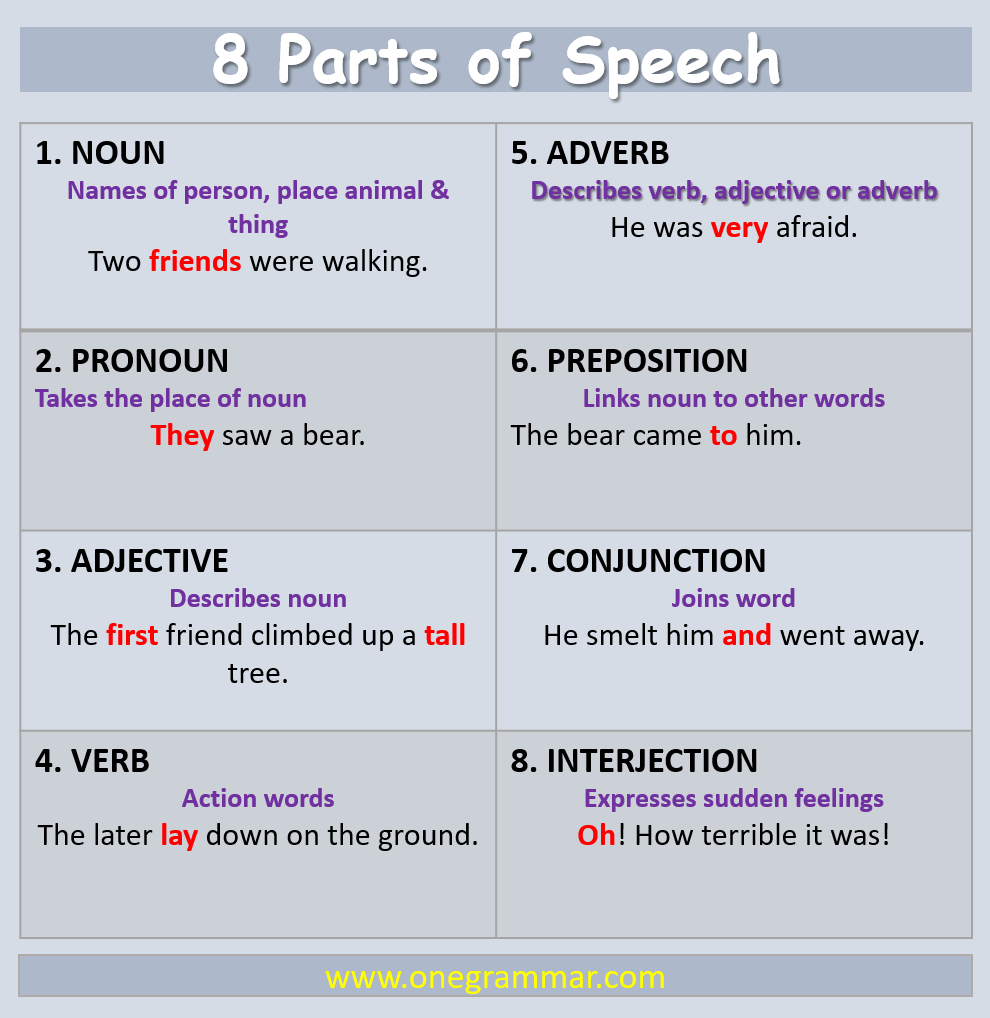
English words are divided into eight groups called eight parts of speech. Let us understand each group clearly.
In traditional grammar, there are eight parts of speech:
1. Noun (Naming Word)
You just read the following words: vegetables, fruits, fish, rice, oil, biscuits, soap, shampoo.
All these are naming words. In grammar, naming words are called nouns.
What is a noun? A noun is a word that names a person, a place, a thing, or an idea. Examples: 2. Pronoun (Replacing Word) Suppose you are talking about your father again and again: “Father went to the market. Father bought fish. Father brought vegetables.” It sounds repetitive. So instead of saying “father” again and again, you say “he”. “Father went to the market. He bought fish. He brought vegetables.” Words like you, he, she, they replace nouns. These words are replacing words. In grammar, replacing words are called pronouns. Pronouns make sentences smoother and shorter. 3. Adjective (Describing Word) In the grocery bag, there may be fresh fish, ripe mangoes, or big potatoes. These words tell us more about nouns. They are "describing words". In grammar, describing words are called adjectives. What is an adjective? An adjective is a word that describes a noun or a pronoun. Examples:
4. Verb (Action Word)
In the grocery story, your father went, bought, and brought items. You organized and kept them.
These words show action. They are action words. In grammar, action words are called verbs.
What is a verb? A verb is a word that shows action or state of being. Examples:
5. Adverb (When, Where, Why, How)
In the grocery story:
- Your father went to the market today.
- He bought many things there.
- You arranged the items carefully.
These words tell us when, where or how something happens. They are called adverbs.
What is an adverb? An adverb is a word that describes a verb, an adjective, or another adverb. Examples:
Adverbs give extra information about actions. They tell when, where, why or how something happens.
6. Preposition (Position Word)
In the grocery story:
- The fish is in the fridge.
- The bag is on the table.
- The vegetables are under the sink.
Words like in, on, under show position. They are position words. In grammar, position words are called prepositions.
What is a preposition? A preposition is a word that connects a noun or pronoun to the other words within a sentence. Examples: Prepositions tell us place, time, position or direction. 7. Conjunction (Joining Word) Suppose you say: Father bought rice and oil. We wanted mangoes, but they were not fresh. Words like “and” and “but” join words or sentences. They are joining words. In grammar, joining words are called conjunctions. What is a conjunction? A conjunction is a word that joins words, phrases, clauses, or sentences. Examples: Conjunctions are like glue. They connect ideas together. 8. Interjection (Feeling Word) When your father brought many chocolates, you might say, “Wow!” If the fish smells bad, you might say, “Oh no!” Words like “wow,” “oh,” and “alas” show strong feelings. They are feeling words. In grammar, feeling words are called interjections. What is an interjection? An interjection is a word that expresses sudden emotion or surprise. Examples: Interjections show surprise, joy, sadness, or pain. Online Test Below is a 15 minute online test on parts of speech. Login to take the test. Answers wont be submitted unless you login.