

Parts of Direct Speech
In this lesson, you will learn:
Look at this sentence:
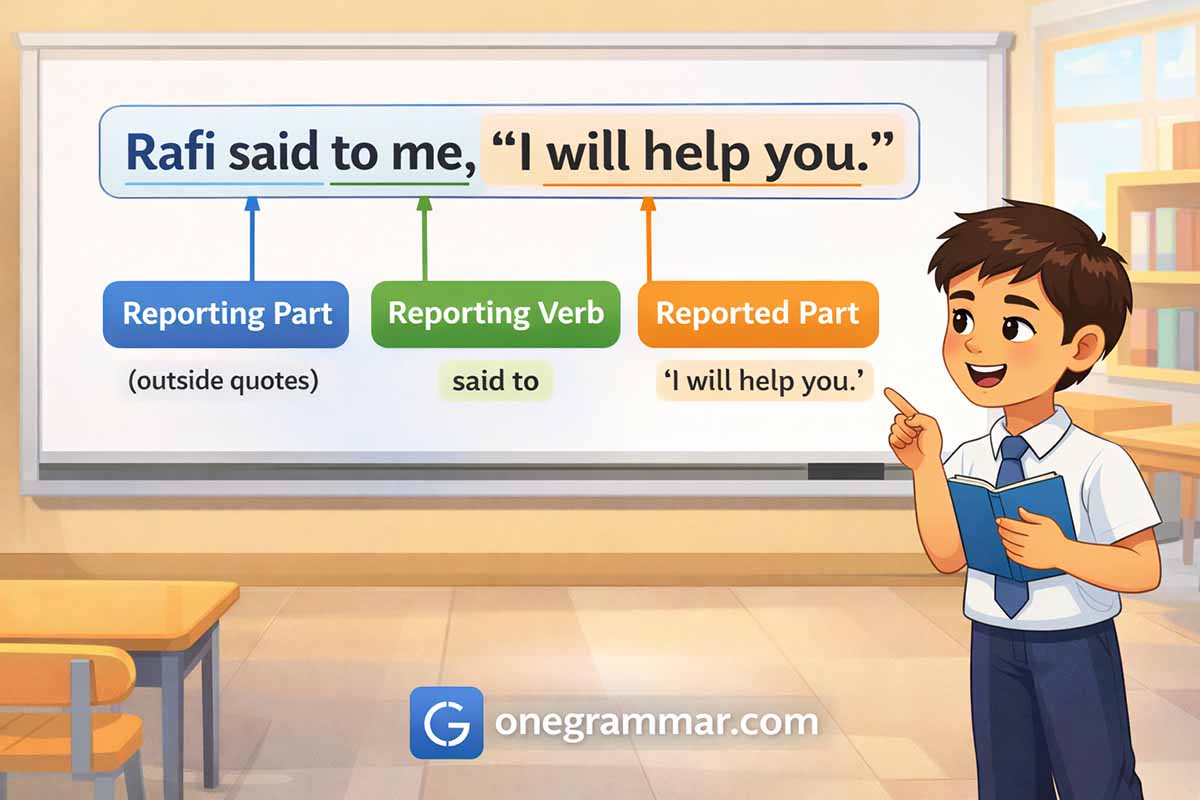
Rafi said to me, “I will help you.”
This is a direct speech sentence.
But before you change it into indirect speech, you must understand its parts.
A direct speech sentence is not just one long sentence. It has important parts. If you can find those parts correctly, narration becomes much easier.
What Is a Direct Speech Sentence
In direct speech, we write the exact words of the speaker.
Example:
Rafi said to me, “I will help you.”
Mina said, “I am tired.”
The teacher said, “Open your book.”
In all these sentences, the speaker’s exact words are written inside quotation marks.
Now let us learn the parts of such sentences.
The Two Main Parts of Direct Speech
A direct speech sentence usually has two main parts:
The reporting part
The reported part
There is also an important verb inside the reporting part. This verb is called the reporting verb.
So in this lesson, you will learn three things:
Reporting part
Reported part
Reporting verb
aaaa
What Is the Reporting Part
The part outside the quotation marks is called the reporting part.
Example:
Rafi said to me, “I will help you.”
Here, the part outside the quotation marks is:
Rafi said to me
So, this is the reporting part.
This part tells us:
Who is speaking
To whom the speaker is speaking
How the speech is being reported
More examples:
Mina said, “I am tired.”
Reporting part: Mina said
The teacher said to the students, “Open your books.”
Reporting part: The teacher said to the students
Mother told me, “Finish your homework.”
Reporting part: Mother told me
Easy idea:
If the words are outside the quotation marks, they usually belong to the reporting part.
What Is the Reported Part
The part inside the quotation marks is called the reported part.
Example:
Rafi said to me, “I will help you.”
Here, the part inside the quotation marks is:
“I will help you.”
So, this is the reported part.
This part contains the actual words spoken by the speaker.
More examples:
Mina said, “I am tired.”
Reported part: “I am tired.”
The teacher said to the students, “Open your books.”
Reported part: “Open your books.”
Mother told me, “Finish your homework.”
Reported part: “Finish your homework.”
Easy idea:
If the words are inside the quotation marks, they belong to the reported part.
What Is the Reporting Verb
The verb in the reporting part is called the reporting verb.
Look again:
Rafi said to me, “I will help you.”
The reporting part is:
Rafi said to me
Now find the verb in that part:
said to
So, the reporting verb is:
said to
More examples:
Mina said, “I am tired.”
Reporting verb: said
The teacher asked me, “Are you ready?”
Reporting verb: asked
Mother told me, “Sit down.”
Reporting verb: told
The reporting verb is very important because in later lessons it often changes when we convert direct speech into indirect speech.
One Sentence Step by Step
Now let us study one sentence carefully.
Sentence:
The girl said to her friend, “I know the answer.”
Step 1
Find the quotation marks.
The words inside the quotation marks are:
“I know the answer.”
So, this is the reported part.
Step 2
Now look at the words outside the quotation marks:
The girl said to her friend
So, this is the reporting part.
Step 3
Find the verb in the reporting part:
said to
So, this is the reporting verb.
This is the easiest method.
More Worked Examples
Example 1
Sentence:
Rina said, “I am happy.”
Reporting part:
Rina said
Reporting verb:
said
Reported part:
“I am happy.”
Explanation:
The outside part is the reporting part.
The inside part is the reported part.
The verb in the outside part is the reporting verb.
Example 2
Sentence:
The boy said to me, “You are kind.”
Reporting part:
The boy said to me
Reporting verb:
said to
Reported part:
“You are kind.”
Explanation:
The speaker is the boy.
The listener is me.
The actual spoken words are inside the quotation marks.
Example 3
Sentence:
Father told me, “Work hard.”
Reporting part:
Father told me
Reporting verb:
told
Reported part:
“Work hard.”
Explanation:
Here the reporting verb is not said. It is told.
So remember: the reporting verb can be said, said to, told, asked, and many others.
Example 4
Sentence:
The teacher asked the student, “Why are you late?”
Reporting part:
The teacher asked the student
Reporting verb:
asked
Reported part:
“Why are you late?”
Explanation:
Even when the sentence is a question, the parts are found in the same way.
Outside part is the reporting part.
Inside part is the reported part.
Why This Lesson Is Important
Many students try to change narration without first identifying the parts of the sentence.
That creates confusion.
If you first identify:
The reporting part
The reported part
The reporting verb
Then narration becomes much easier.
This is why this lesson is a foundation lesson.
How to Find the Parts Easily
Use this simple method every time:
First, find the quotation marks.
Second, mark the words inside the quotation marks. That is the reported part.
Third, mark the words outside the quotation marks. That is the reporting part.
Fourth, find the verb in the reporting part. That is the reporting verb.
Follow this method again and again until it becomes easy.
Common Mistakes
Mistake 1
Thinking that the reported part is outside the quotation marks.
This is wrong. The reported part stays inside the quotation marks.
Mistake 2
Thinking that the whole sentence is the reporting part.
This is wrong. Only the part outside the quotation marks is the reporting part.
Mistake 3
Thinking that the whole reporting part is the reporting verb.
This is wrong. The reporting verb is only the verb inside the reporting part.
Mistake 4
Ignoring words like me, him, her, us, or the students.
These words are important because they show the listener.
Quick Revision
A direct speech sentence has an outside part and an inside part.
The outside part is called the reporting part.
The inside part is called the reported part.
The verb in the reporting part is called the reporting verb.
Practice
A. Write the reporting part, reporting verb, and reported part
1. Rafi said, “I am hungry.”
2. Mina said to me, “I know you.”
3. Father told me, “Work hard.”
4. The teacher asked the boy, “Why are you absent?”
5. Mother said, “I love you.”
6. The girl said to her friend, “You are very kind.”
B. Choose the correct answer
1. In direct speech, the reported part stays
inside quotation marks
outside quotation marks
2. In the sentence “He said, ‘I am tired,’” the reporting verb is
He
said
tired
3. In the sentence “Mother told me, ‘Read the lesson,’” the reporting part is
Read the lesson
Mother told me
told me read
4. In the sentence “The teacher asked me, ‘Where do you live?’” the reported part is
The teacher asked me
asked
“Where do you live?”
C. Match
1. Reporting part
2. Reported part
3. Reporting verb
a. The verb in the reporting part
b. The part inside quotation marks
c. The part outside quotation marks
D. Find the parts
Sentence:
The boy said to his mother, “I will come soon.”
Write:
Reporting part
Reporting verb
Reported part
Answers
A.
1. Rafi said, “I am hungry.”
Reporting part: Rafi said
Reporting verb: said
Reported part: “I am hungry.”
2. Mina said to me, “I know you.”
Reporting part: Mina said to me
Reporting verb: said to
Reported part: “I know you.”
3. Father told me, “Work hard.”
Reporting part: Father told me
Reporting verb: told
Reported part: “Work hard.”
4. The teacher asked the boy, “Why are you absent?”
Reporting part: The teacher asked the boy
Reporting verb: asked
Reported part: “Why are you absent?”
5. Mother said, “I love you.”
Reporting part: Mother said
Reporting verb: said
Reported part: “I love you.”
6. The girl said to her friend, “You are very kind.”
Reporting part: The girl said to her friend
Reporting verb: said to
Reported part: “You are very kind.”
B.
1. inside quotation marks
2. said
3. Mother told me
4. “Where do you live?”
C.
1 - c
2 - b
3 - a
D.
Sentence:
The boy said to his mother, “I will come soon.”
Reporting part:
The boy said to his mother
Reporting verb:
said to
Reported part:
“I will come soon.”
Self Check
Now ask yourself:
Can I find the quotation marks in a direct speech sentence
Can I identify the reporting part
Can I identify the reported part
Can I find the reporting verb
Can I explain the difference between the reporting part and the reporting verb
Homework
Write five direct speech sentences of your own.
Then underline the reporting part, circle the reporting verb, and write the reported part separately.