

What Is Direct and Indirect Speech
In this lesson, you will learn:
1.
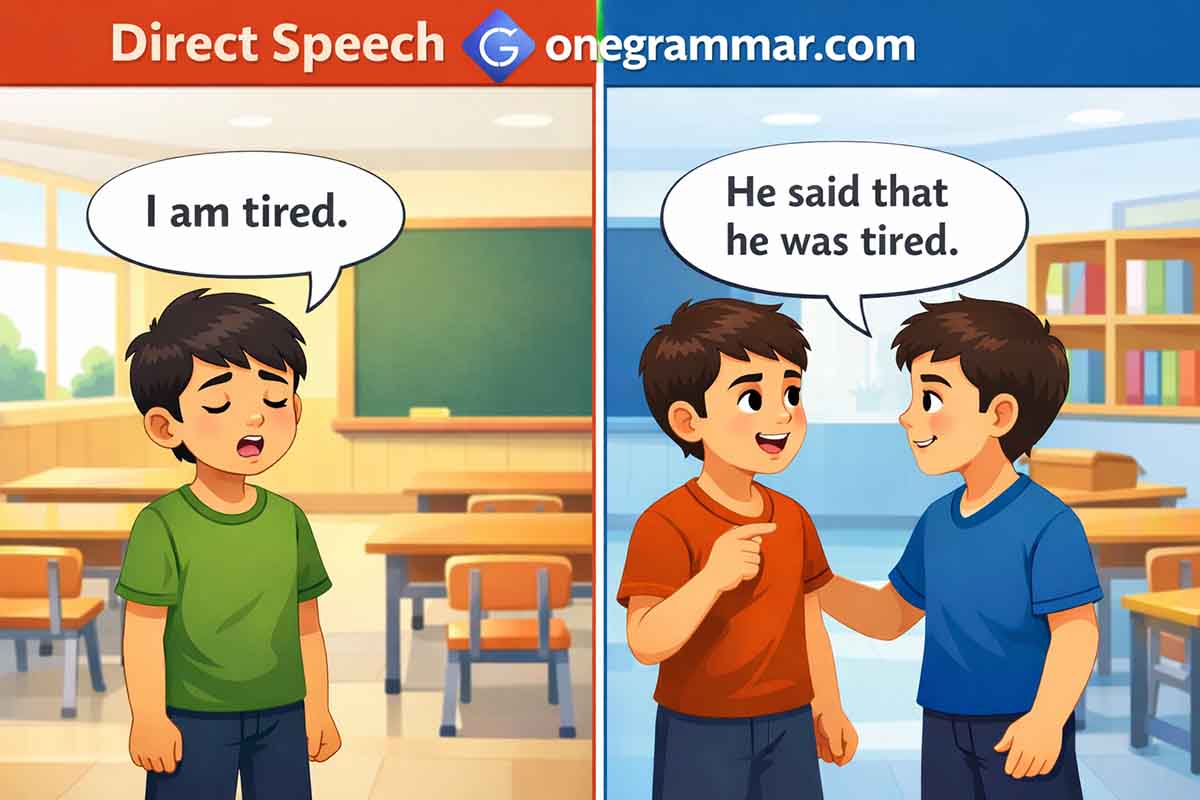
We often tell other people what someone said.
Suppose your friend says, “I am tired.”
Now you want to tell this to another person. You may say:
He said, “I am tired.”
Or
He said that he was tired.
Both sentences carry the same meaning, but their forms are different. This is where narration begins.
What Is Narration
Narration means reporting or telling what someone says.
When we report a speaker’s words, we usually do it in two ways:
Direct Speech
Indirect Speech
So, narration is the process of changing one form into the other.
2. Direct Speech
Direct speech gives the speaker’s exact words.
Example:
Rafi said, “I am tired.”
Mina said, “I like mangoes.”
The teacher said, “Open your book.”
Look carefully at these examples:
The speaker’s exact words are written inside quotation marks.
The sentence shows exactly what the speaker said.
So we can say:
Direct speech uses the original words of the speaker.
3. Indirect Speech
Indirect speech tells the speaker’s words in another form without using the exact same structure.
Example:
Rafi said that he was tired.
Mina said that she liked mangoes.
The teacher told us to open our books.
Look carefully:
There are no quotation marks here.
The meaning stays the same.
But the words and structure change.
So we can say:
Indirect speech expresses the same idea in a changed form.
Direct and Indirect Speech Side by Side
Direct: Rafi said, “I am tired.”
Indirect: Rafi said that he was tired.
Direct: Mina said, “I like mangoes.”
Indirect: Mina said that she liked mangoes.
Direct: The boy said, “We are playing.”
Indirect: The boy said that they were playing.
What Do You Notice
Now notice these differences:
In direct speech, quotation marks are used.
In indirect speech, quotation marks are not used.
In direct speech, the speaker’s exact words are kept.
In indirect speech, the same meaning is expressed in a different way.
Easy Rule
Direct speech means exact words.
Indirect speech means reported meaning.
How to Identify Direct and Indirect Speech
Ask yourself these questions:
Does the sentence have quotation marks
If yes, it is usually direct speech.
Does the sentence tell the idea without quotation marks
If yes, it is usually indirect speech.
Examples:
He said, “I am happy.”
This is direct speech.
He said that he was happy.
This is indirect speech.
Mother said, “Come here.”
This is direct speech.
Mother told me to go there.
This is indirect speech.
More Examples for Self Learning
Example 1
Direct: She said, “I am busy.”
Indirect: She said that she was busy.
Explanation:
In the first sentence, the exact words are inside quotation marks.
In the second sentence, the same idea is reported in another form.
Example 2
Direct: They said, “We will go.”
Indirect: They said that they would go.
Explanation:
The meaning is the same.
But the indirect form does not keep the sentence exactly as it was spoken.
Example 3
Direct: Father said, “You are a good boy.”
Indirect: Father said that I was a good boy.
Explanation:
Here the words change according to meaning and person.
Important Note
At this stage, do not worry too much about all the grammar changes.
In this lesson, your job is only to understand:
What direct speech is
What indirect speech is
How one is different from the other
You will learn the detailed rules step by step in the next lessons.
Common Mistakes
Wrong idea 1
Direct speech and indirect speech are completely different in meaning.
This is not true. Their meaning is usually the same.
Wrong idea 2
If there are quotation marks, it may still be indirect speech.
This is usually not true. Quotation marks generally show direct speech.
Wrong idea 3
Indirect speech always uses exactly the same words.
No. Indirect speech changes the form.
Quick Revision
Narration means reporting what someone says.
There are two main kinds of narration: direct speech and indirect speech.
Direct speech shows exact words.
Indirect speech reports the same idea in another form.
Quotation marks are used in direct speech.
Quotation marks are not used in indirect speech.
Practice
A. Write Direct or Indirect
1. He said, “I am hungry.”
2. She said that she was ill.
3. The teacher said, “Work hard.”
4. They said that they were happy.
5. Rina said, “I can do it.”
6. Father said that he would help me.
B. Match the pairs
1. He said, “I am ready.”
2. Mina said, “I like flowers.”
3. They said, “We are playing.”
a. Mina said that she liked flowers.
b. They said that they were playing.
c. He said that he was ready.
C. Fill in the blanks
1. Direct speech uses the exact ______ of the speaker.
2. Indirect speech tells the same ______ in another form.
3. Quotation marks are used in ______ speech.
4. Quotation marks are not used in ______ speech.
Answers
A.
1. Direct
2. Indirect
3. Direct
4. Indirect
5. Direct
6. Indirect
B.
1 - c
2 - a
3 - b
C.
1. words
2. idea
3. direct
4. indirect
Self Check
Now check yourself.
Can you explain what narration is
Can you tell the difference between direct and indirect speech
Can you identify a sentence with quotation marks
Can you change one direct sentence into an indirect one by observing the example
Homework
Write three examples of direct speech.
Then write their indirect forms by following the examples in this lesson.