

Special Cases in Tense Change
What You Will Learn
In this lesson, you will learn:
Look at these two sentences:
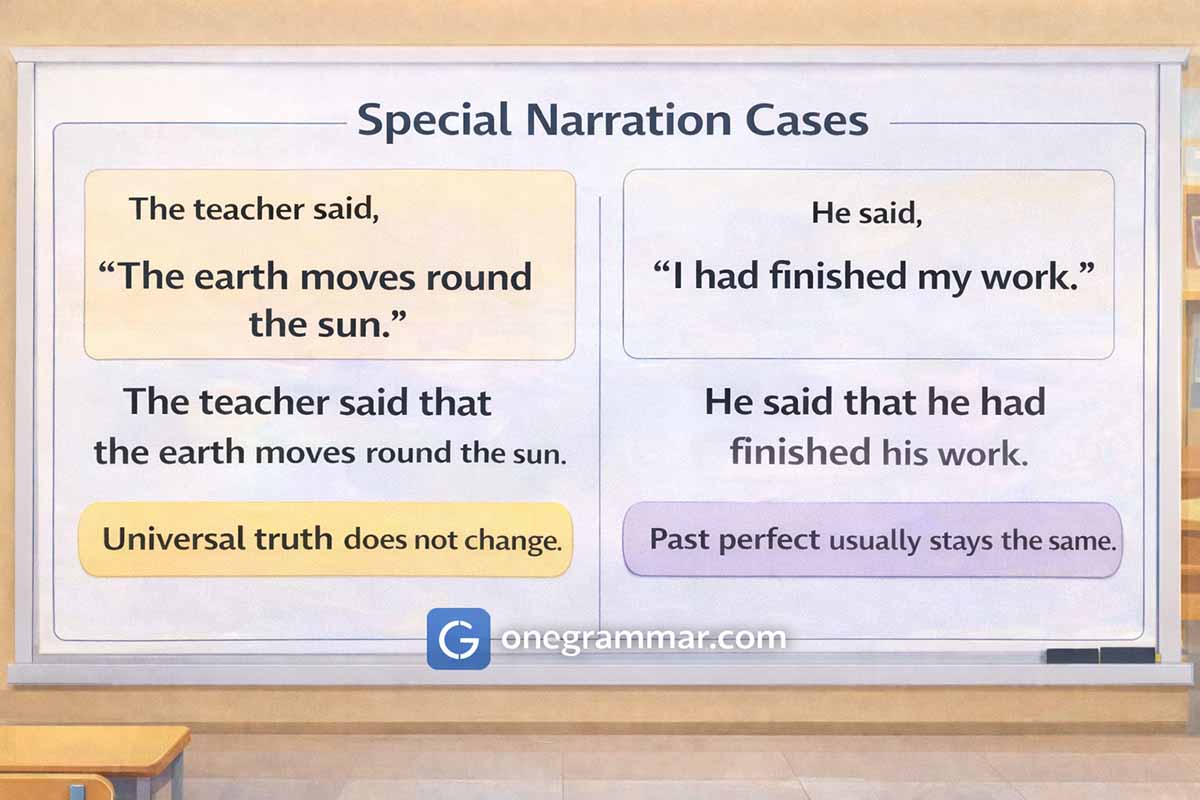
The teacher said, “The earth moves round the sun.”
The teacher said that the earth moves round the sun.
He said, “I had finished my work.”
He said that he had finished his work.
Now look carefully.
In the first sentence, moves did not change.
In the second sentence, had finished also did not change.
Why did they not change
Because these are special cases.
In narration, we often use backshift. But not every sentence changes in the same way. Some sentences follow special rules.
Why This Lesson Is Important
In the last lesson, you learned that when the reporting verb is in the past, the tense usually goes one step back.
That rule is correct.
But some students start changing every sentence in the same way. Then they make mistakes.
For example, they may write:
The teacher said that the earth moved round the sun.
He said that he had had finished his work.
These are wrong in basic narration rules.
So you must learn the special cases clearly.
The Two Important Special Cases
In this lesson, we will learn two very important special cases:
Universal truth
Past perfect
These two usually do not change.
Special Case 1: Universal Truth
If the reported speech expresses a universal truth, scientific fact, natural law, or proverb, the tense usually does not change.
Easy idea:
A universal truth is true all the time. It was true before, it is true now, and it will be true later.
So we usually do not backshift it.
Examples of universal truth:
The earth moves round the sun
Water boils at one hundred degrees Celsius
The sun rises in the east
Honesty is the best policy
Example 1
Direct:
The teacher said, “The earth moves round the sun.”
Indirect:
The teacher said that the earth moves round the sun.
Explanation:
moves did not change to moved
because this is a scientific fact
Example 2
Direct:
The scientist said, “Water boils at one hundred degrees Celsius.”
Indirect:
The scientist said that water boils at one hundred degrees Celsius.
Explanation:
boils did not change
because this is a scientific fact
Example 3
Direct:
Father said, “Honesty is the best policy.”
Indirect:
Father said that honesty is the best policy.
Explanation:
is did not change to was
because this is a proverb or general truth
Example 4
Direct:
The teacher said, “The sun rises in the east.”
Indirect:
The teacher said that the sun rises in the east.
Explanation:
rises stays rises
because it is always true
So remember:
Universal truth usually does not change.
How to Recognize Universal Truth
Ask yourself:
Is this something always true
Is it a scientific fact
Is it a natural law
Is it a proverb or general truth
If the answer is yes, then tense usually stays the same.
Special Case 2: Past Perfect
Past perfect usually does not change in narration.
Past perfect form:
had plus V3
Easy idea:
Past perfect already shows an earlier past action.
So it usually does not go another step back.
Example 1
Direct:
He said, “I had finished my work.”
Indirect:
He said that he had finished his work.
Explanation:
had finished stayed had finished
Example 2
Direct:
Mina said, “I had seen the film before.”
Indirect:
Mina said that she had seen the film before.
Explanation:
had seen stayed had seen
Example 3
Direct:
The boy said, “I had gone there.”
Indirect:
The boy said that he had gone there.
Explanation:
had gone did not change again
Example 4
Direct:
She said, “I had written the letter.”
Indirect:
She said that she had written the letter.
Explanation:
had written stayed the same
So remember:
Past perfect usually stays the same.
Why Past Perfect Does Not Usually Change
Past perfect already means past before past.
So it is already back enough.
That is why we usually do not change it again.
One Sentence Step by Step
Let us study one universal truth sentence carefully.
Sentence:
The teacher said, “The earth moves round the sun.”
Step 1
Check the reporting verb.
It is said, so it is past.
Step 2
Normally we expect backshift.
Step 3
But the reported speech is a scientific fact.
Step 4
So the tense does not change.
Final answer:
The teacher said that the earth moves round the sun.
Another Step by Step Example
Sentence:
He said, “I had finished my work.”
Step 1
Check the reporting verb.
It is said, so it is past.
Step 2
Normally we expect backshift.
Step 3
But the verb is already in past perfect:
had finished
Step 4
Past perfect usually stays the same.
Final answer:
He said that he had finished his work.
Compare Normal Rule and Special Case
Normal backshift:
He said, “I am tired.”
He said that he was tired.
Special case, universal truth:
The teacher said, “The earth moves round the sun.”
The teacher said that the earth moves round the sun.
Special case, past perfect:
He said, “I had finished my work.”
He said that he had finished his work.
This comparison is very important.
Common Mistakes
Mistake 1
Changing universal truth unnecessarily.
Wrong:
The teacher said that the earth moved round the sun.
Correct:
The teacher said that the earth moves round the sun.
Mistake 2
Changing a proverb unnecessarily.
Wrong:
Father said that honesty was the best policy.
Correct:
Father said that honesty is the best policy.
Mistake 3
Changing past perfect again.
Wrong:
He said that he had had finished his work.
Correct:
He said that he had finished his work.
Mistake 4
Forgetting that these are exceptions.
Some students try to apply one step back to every sentence.
That creates errors.
Quick Revision
Remember these two special cases:
Universal truth usually does not change.
Past perfect usually stays the same.
Examples:
The teacher said that the earth moves round the sun.
He said that he had finished his work.
Practice
A. Change into indirect speech
1. The teacher said, “The sun rises in the east.”
2. The scientist said, “Water boils at one hundred degrees Celsius.”
3. Father said, “Honesty is the best policy.”
4. He said, “I had finished my homework.”
5. Mina said, “I had seen the bird before.”
6. The boy said, “I had gone to school.”
7. The teacher said, “Practice makes a man perfect.”
8. She said, “I had written the answer.”
B. Write the correct form
1. The teacher said that the earth ______ round the sun.
2. He said that he had ______ his work.
3. Father said that honesty ______ the best policy.
4. Mina said that she had ______ the letter.
C. Choose the correct answer
1. Universal truth usually
changes to past
does not change
changes to future
2. Past perfect usually
changes again
stays the same
becomes present
3. “The sun rises in the east” is an example of
past perfect
universal truth
future tense
Answers
A.
1. The teacher said that the sun rises in the east.
2. The scientist said that water boils at one hundred degrees Celsius.
3. Father said that honesty is the best policy.
4. He said that he had finished his homework.
5. Mina said that she had seen the bird before.
6. The boy said that he had gone to school.
7. The teacher said that practice makes a man perfect.
8. She said that she had written the answer.
B.
1. moves
2. finished
3. is
4. written
C.
1. does not change
2. stays the same
3. universal truth
Self Check
Now ask yourself:
Can I identify a universal truth sentence
Can I explain why universal truth usually does not change
Can I identify a past perfect form
Can I remember that past perfect usually stays the same
Can I avoid changing these two cases wrongly
Homework
Write three sentences of universal truth in direct speech.
Then change them into indirect speech.
Write three sentences with past perfect in direct speech.
Then change them into indirect speech.