

Pronoun Change in Narration
What You Will Learn
In this lesson, you will learn:
Look at this sentence:
Father said to me, “I will help you.”
Now think carefully.
Who is “I” here
It is Father.
Who is “you” here
It is me.
So when we change the sentence into indirect speech, we cannot keep the same pronouns. We must change them according to meaning.
This is called pronoun change.
Why Pronoun Change Is Important
Many students can remove quotation marks and add that, but they still make mistakes because they do not change the pronouns correctly.
Look at this wrong sentence:
Father said to me that I would help you.
This is wrong because:
“I” does not mean the speaker anymore
“you” does not match the listener correctly
Correct sentence:
Father told me that he would help me.
So, pronoun change is one of the most important parts of narration.
What Is a Pronoun
A pronoun is a word used instead of a noun.
Examples:
I
we
you
he
she
they
me
us
him
her
them
my
your
our
their
In narration, these words often change.
The Three Main Kinds of Pronouns in Narration
For narration, we usually think of pronouns in three groups:
First person
Second person
Third person
Now let us understand each group.
First Person Pronouns
First person pronouns are:
I
me
my
mine
myself
we
us
our
ours
ourselves
Rule:
First person changes according to the speaker.
Easy idea:
Find the speaker first. Then change the first person pronoun according to that speaker.
Example 1
Direct:
Rafi said, “I am tired.”
Who is the speaker
Rafi
So “I” means Rafi.
Indirect:
Rafi said that he was tired.
Here:
I becomes he
Example 2
Direct:
Mina said, “I like flowers.”
Speaker:
Mina
Indirect:
Mina said that she liked flowers.
Here:
I becomes she
Example 3
Direct:
The boys said, “We are ready.”
Speaker:
The boys
Indirect:
The boys said that they were ready.
Here:
We becomes they
So remember:
First person follows the speaker.
Second Person Pronouns
Second person pronouns are:
you
your
yours
yourself
yourselves
Rule:
Second person changes according to the listener.
Easy idea:
Find who is being spoken to. Then change the second person pronoun according to that listener.
Example 1
Direct:
Father said to me, “You are a good boy.”
Who is the listener
me
So “you” means me.
Indirect:
Father told me that I was a good boy.
Here:
you becomes I
Example 2
Direct:
The teacher said to Rina, “You are very careful.”
Listener:
Rina
Indirect:
The teacher told Rina that she was very careful.
Here:
you becomes she
Example 3
Direct:
Mother said to us, “You should work hard.”
Listener:
us
Indirect:
Mother told us that we should work hard.
Here:
you becomes we
So remember:
Second person follows the listener.
Third Person Pronouns
Third person pronouns are:
he
she
it
they
him
her
them
his
her
their
theirs
Rule:
Third person usually does not change.
Easy idea:
If the pronoun already refers to another person or thing, it usually stays the same.
Example 1
Direct:
Rafi said, “He is my friend.”
Indirect:
Rafi said that he was his friend.
In basic narration lessons, we usually say:
the third person pronoun he stays the same
Example 2
Direct:
Mina said, “They are playing.”
Indirect:
Mina said that they were playing.
Here:
they stays they
Example 3
Direct:
The boy said, “She is kind.”
Indirect:
The boy said that she was kind.
Here:
she stays she
So remember:
Third person usually stays the same.
The Golden Rule of Pronoun Change
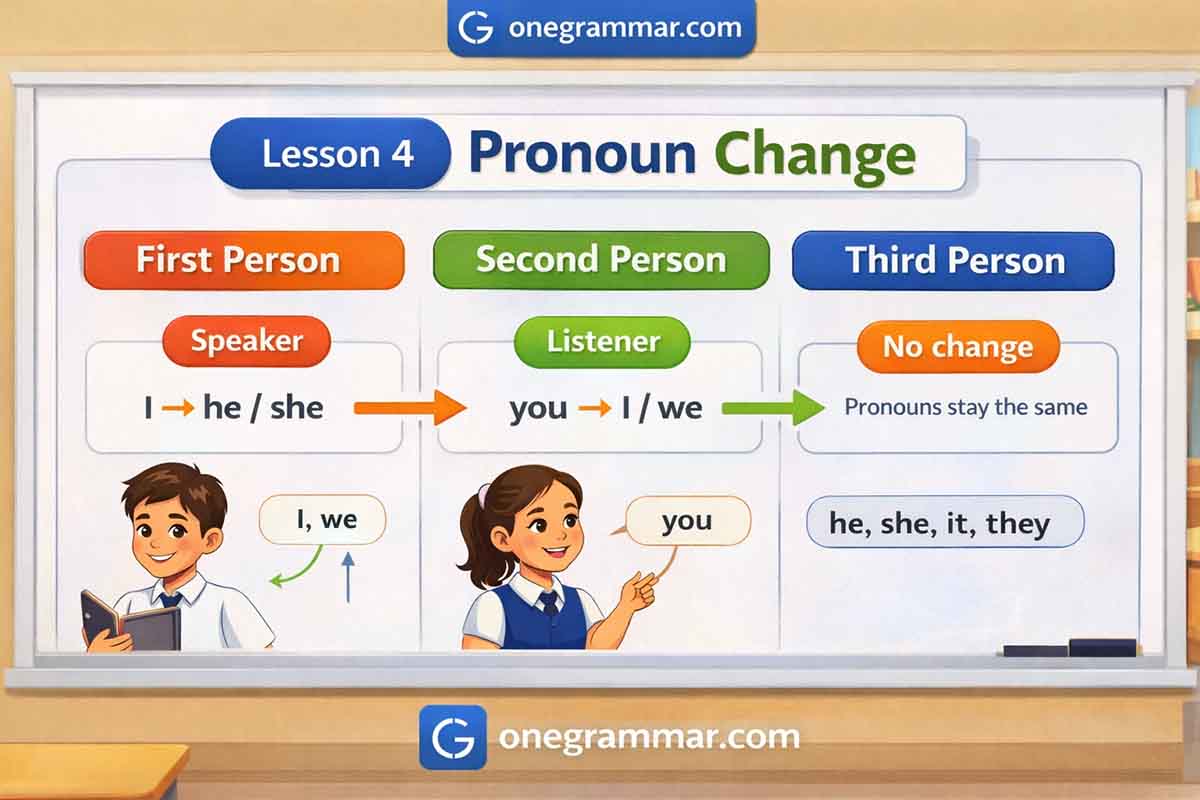
You can remember pronoun change with one simple rule:
First person follows the speaker.
Second person follows the listener.
Third person usually stays the same.
This is the main rule of pronoun change in narration.
One Sentence Step by Step
Let us study one sentence carefully.
Sentence:
Father said to me, “I will help you.”
Step 1
Find the speaker.
Speaker:
Father
So “I” refers to Father.
That means:
I becomes he
Step 2
Find the listener.
Listener:
me
So “you” refers to me.
That means:
you becomes me
Step 3
Write the sentence in indirect speech.
Father told me that he would help me.
This is the correct answer.
More Worked Examples
Example 1
Direct:
She said, “I am happy.”
Speaker:
She
Indirect:
She said that she was happy.
Explanation:
“I” refers to the speaker, so it changes to she.
Example 2
Direct:
Karim said to me, “You are my friend.”
Speaker:
Karim
Listener:
me
Indirect:
Karim told me that I was his friend.
Explanation:
you becomes I because it refers to the listener
my becomes his because it refers to the speaker
Example 3
Direct:
Rina said, “We are ready.”
Speaker:
Rina and others
Indirect:
Rina said that they were ready.
Explanation:
we becomes they because it refers to the speaker group
Example 4
Direct:
The teacher said to us, “You are good students.”
Listener:
us
Indirect:
The teacher told us that we were good students.
Explanation:
you becomes we because it refers to the listener group
Example 5
Direct:
Mina said, “They are playing outside.”
Indirect:
Mina said that they were playing outside.
Explanation:
they is third person, so it usually stays the same
Common Mistakes
Mistake 1
Changing every pronoun in the same way.
This is wrong because each pronoun changes for a different reason.
Mistake 2
Forgetting to find the speaker first.
Without finding the speaker, you cannot change first person correctly.
Mistake 3
Forgetting to find the listener.
Without finding the listener, you cannot change second person correctly.
Mistake 4
Changing third person unnecessarily.
Third person usually stays the same.
Mistake 5
Looking only at the word, not the meaning.
In narration, meaning is very important.
Quick Revision
Pronouns often change in narration.
First person changes according to the speaker.
Second person changes according to the listener.
Third person usually stays the same.
Practice
A. Change the pronouns and write the indirect speech
1. Rafi said, “I am tired.”
2. Mina said, “I will come.”
3. Father said to me, “You are honest.”
4. The teacher said to Rina, “You are attentive.”
5. The boys said, “We will win.”
6. Mother said to us, “You should listen carefully.”
7. Rafi said, “They are playing.”
8. The girl said to me, “You know my brother.”
B. Write the correct pronoun
1. Rina said, “I am busy.”
Rina said that ______ was busy.
2. Father said to me, “You are brave.”
Father told me that ______ was brave.
3. The boys said, “We are ready.”
The boys said that ______ were ready.
4. Mina said, “They are my friends.”
Mina said that they were ______ friends.
C. Choose the correct answer
1. First person follows the
speaker
listener
third person
2. Second person follows the
speaker
listener
quotation marks
3. Third person
always changes
usually stays the same
always becomes first person
Answers
A.
1. Rafi said that he was tired.
2. Mina said that she would come.
3. Father told me that I was honest.
4. The teacher told Rina that she was attentive.
5. The boys said that they would win.
6. Mother told us that we should listen carefully.
7. Rafi said that they were playing.
8. The girl told me that I knew her brother.
B.
1. she
2. I
3. they
4. her
C.
1. speaker
2. listener
3. usually stays the same
Self Check
Now ask yourself:
Can I find the speaker in a sentence
Can I find the listener in a sentence
Can I change first person correctly
Can I change second person correctly
Can I remember that third person usually stays the same
Homework
Write five direct speech sentences of your own.
Use at least one sentence with I, one with we, one with you, and one with they.
Then change them into indirect speech