

The 6 Steps of Changing Direct Speech to Indirect Speech
What You Will Learn
In this lesson, you will learn:
In the previous lessons, you learned:
What narration is
What direct and indirect speech are
What the parts of a sentence are
Now it is time to learn how to change a sentence.
Many students get confused because they try to change everything at once.
But narration is actually very simple if you follow steps.
There are 6 basic steps.
If you follow them one by one, you can change any sentence easily.
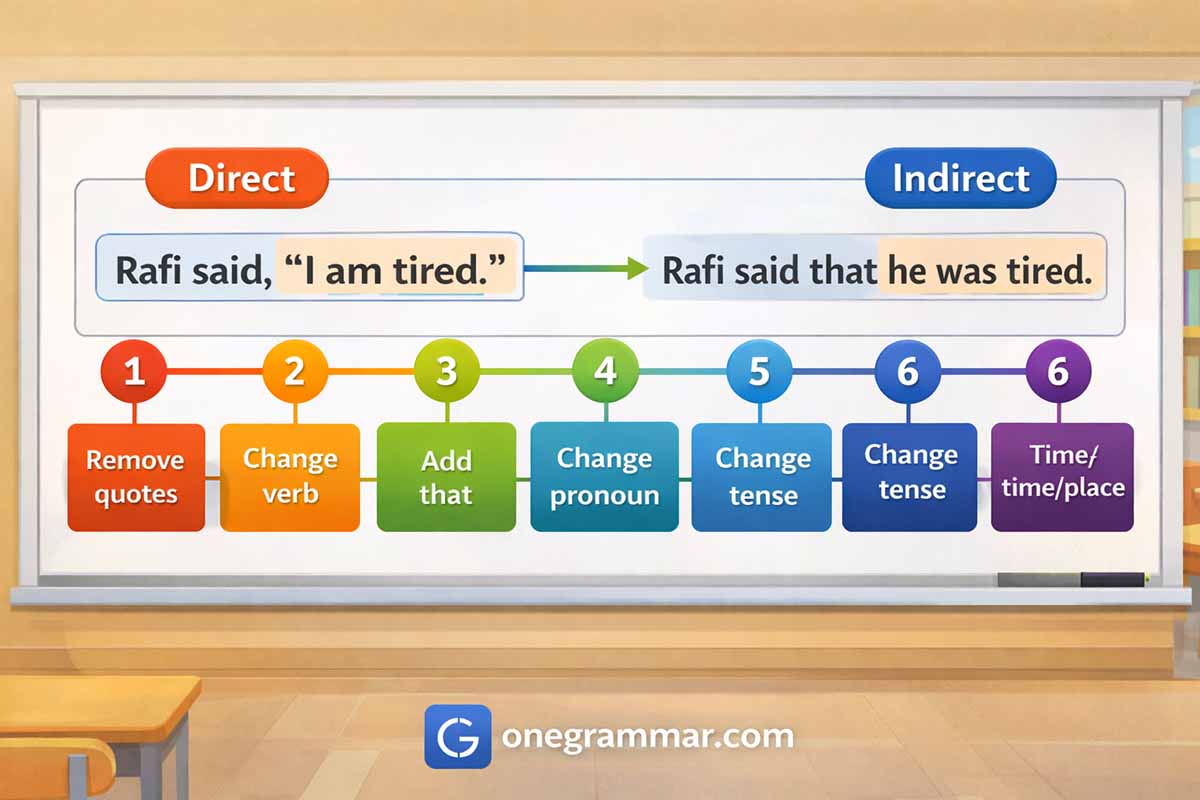
The 6 Steps (Overview)
Here are the 6 steps:
Step 1: Remove quotation marks
Step 2: Change the reporting verb
Step 3: Add that or a link word
Step 4: Change pronouns
Step 5: Change tense
Step 6: Change time and place words
You do not need to remember everything at once.
We will understand each step with examples.
Let Us Start with One Sentence
Direct Speech:
Rafi said, “I am tired.”
We will change this into indirect speech step by step.
Step 1: Remove Quotation Marks
Direct:
Rafi said, “I am tired.”
Indirect:
Rafi said that I am tired
Explanation:
Remove the quotation marks
Write the sentence as part of one sentence
Step 2: Change the Reporting Verb
Sometimes the reporting verb changes.
Example:
said to → told
said → said (sometimes no change)
In this sentence:
Rafi said → no change
So it remains:
Rafi said that I am tired
Step 3: Add “that”
We usually add “that” to connect the two parts.
So:
Rafi said that I am tired
Explanation:
“That” connects the reporting part and reported part.
Step 4: Change Pronouns
Now look at “I”
Who is “I”?
“I” refers to Rafi
So:
I → he
Now the sentence becomes:
Rafi said that he is tired
Step 5: Change Tense
Direct:
I am tired
Indirect:
he was tired
So:
am → was
Now the sentence becomes:
Rafi said that he was tired
Step 6: Change Time and Place Words
In this sentence, there is no time or place word.
So no change is needed.
Final Answer:
Rafi said that he was tired
Full Example Step by Step
Direct:
Mina said, “I like mangoes.”
Step 1: Remove quotation marks
Mina said that I like mangoes
Step 2: Reporting verb stays same
Step 3: Add that (already added)
Step 4: I → she
Mina said that she likes mangoes
Step 5: likes → liked
Mina said that she liked mangoes
Step 6: No time change
Final:
Mina said that she liked mangoes
Another Example
Direct:
The boy said to me, “I will help you.”
Step 1:
Remove quotes
The boy said to me that I will help you
Step 2:
said to → told
The boy told me that I will help you
Step 3:
that already added
Step 4:
I → he
you → me
The boy told me that he will help me
Step 5:
will → would
The boy told me that he would help me
Step 6:
No change
Final:
The boy told me that he would help me
Why These Steps Are Important
If you follow steps:
You will not forget anything
You will not mix rules
You will feel confident
If you skip steps:
You may make mistakes
You may get confused
So always follow the steps in order.
Common Mistakes
Mistake 1
Forgetting to remove quotation marks
Mistake 2
Not changing pronouns
Mistake 3
Not changing tense
Mistake 4
Forgetting to add “that”
Mistake 5
Trying to change everything at once
Quick Revision
There are 6 steps:
Remove quotation marks
Change reporting verb
Add that
Change pronoun
Change tense
Change time and place
Follow these steps every time.
Practice
A. Change into indirect speech
1. Rafi said, “I am happy.”
2. Mina said, “I like tea.”
3. The boy said to me, “I will come.”
4. She said, “I am tired.”
B. Fill in the blanks
1. First step is to remove ______
2. “I” changes according to the ______
3. Tense usually changes from present to ______
4. “that” is used to ______ the sentence
Answers
A.
1. Rafi said that he was happy
2. Mina said that she liked tea
3. The boy told me that he would come
4. She said that she was tired
B.
1. quotation marks
2. speaker
3. past
4. connect
Self Check
Can I follow all 6 steps
Can I change pronouns correctly
Can I change tense correctly
Can I explain each step
Homework
Write 5 direct speech sentences.
Change them into indirect speech using all 6 steps.